
What’s a Lutheran?
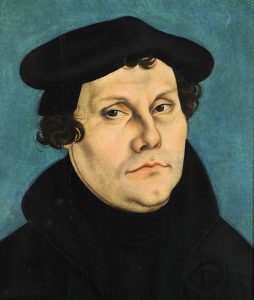
Martin Luther
Around five hundred years ago in Germany, a young monk named Martin Luther was terrified of God. He became a monk, hoping that by joining the Augustinian Order, he could please God and finally be free from the guilt and oppression of his sins. But it backfired. The more he tried to dedicate himself to God, the more aware he became of his failings, and the more he feared God’s punishment. It was through the study of Scripture that Luther discovered that sinners are declared righteous by God by believing that Jesus Christ took their punishment upon Himself by dying on the cross. Good works do not earn our way into heaven, but are a way of giving thanks to God for His gift of salvation.
In 1517, Luther challenged the practice of selling indulgences (notes of forgiveness authorized by the pope) by posting ninety-five theses (or articles for debate) on the door of the church in Wittenberg. He could not believe that God would sell His forgiveness “like a sack of potatoes.”
Luther was rebuked and later branded as a heretic for his teachings, but he would not be silenced. Instead, he continued to write and preach against the abuses of the medieval church. The more he studied the Bible, the more convinced he became that the church needed a Reformation: it needed to be brought back to the truth of God’s Word.
Among his many achievements, Luther’s greatest was translating the entire Bible into the language of the common people; a translation that not only endured for hundreds of years but also helped shape and unify the German language.
What’s a Lutheran Today?
Martin Luther never aspired to start his own church; he only wanted to point people back to Christ and the truth of God’s Word. Those who followed his teachings were initially called “Lutherans” as an insult, but they (along with Luther himself) preferred to be known as “Christians”—for they were really following the teachings of Christ. Today, a true “Lutheran” is nothing more and nothing less than a Bible-believing Christian who confesses that we are saved by GOD’S GRACE ALONE, through FAITH ALONE, in CHRIST ALONE.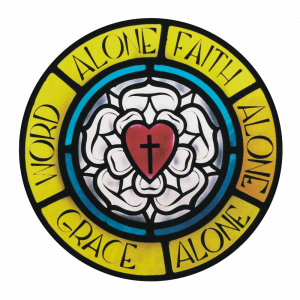
Lutheran Christians usually study the basics of the faith using Luther’s Small Catechism as a guide. This teaching tool walks a student through the meaning of the Ten Commandments, the Apostles’ Creed, Baptism, Holy Communion, Confession, and the Lord’s Prayer. Modern versions supply extensive notes and Scripture references to Luther’s original work.
The chief articles or main teachings of the Christian faith are compiled in the Lutheran Confessions or Book of Concord of 1580 to which all pastors and congregations of Lutheran Church–Canada subscribe. We confess them because they are drawn from and based on the Holy Scriptures.
The Holy Scriptures are the only authority and basis for the Christian faith, teaching, and life.
What Makes Us Unique?
 Every Church that is truly Christian agrees with the substance of the Apostles’ Creed (even if it isn’t used in worship). However, as Lutheran Christians, we celebrate these distinctive traits:
1) Christ-Centred.
Jesus Christ is the focal point of our theology. Where some churches tend to emphasize “the Sovereignty of God” or “how one should live” in their teachings, the Lutheran Church stresses the Gospel of Jesus Christ—crucified for our sins and risen from the dead—as being the key to understanding the Bible and applying it to our lives.
We affirm that the Bible was written to reveal Christ as our Saviour-King, the fulfillment of God’s plan to save the world. To the Jews who refused to believe him, Jesus said: “You diligently study the Scriptures because you think that by them you possess eternal life. These are the Scriptures that testify about me, yet you refuse to come to me to have life” (John 5:39).
2) Means of Grace.
We believe that God comes to us with His salvation through His Word, Holy Baptism, and the Lord’s Supper. God creates and nourishes faith through these “means of grace.”
First, the Word of God
The Word of God is “living and active” (Hebrews 4:12), and “the message of the cross” is “the power of God” for our salvation (1 Corinthians 1:18; see also Romans 10:14-17). We preach and teach God’s Word with the expectation that through it, God will save souls and change lives.
God’s Word has two teachings: the Law and the Gospel. The Law is everything God demands of us, thus revealing our sin and need for a Saviour. Meanwhile, the Gospel is everything that God does for us and reveals Jesus as our Saviour. Only the Gospel—what God does for us—saves us.
Second, Holy Baptism
Holy Baptism is no mere symbol of rebirth—it is the new birth of “water and the Spirit” (John 3:5). Baptism unites us with Christ in his death and resurrection (Romans 6:3-4), and through baptism God covers, or “clothes”, us with Christ—making us sons of God and heirs of heaven (Galatians 3:26-4:7). For these reasons, St. Paul identifies baptism as a means through which God saves sinful people: “But when the kindness and love of God our Savior appeared, he saved us, not because of righteous things we had done, but because of his mercy. He saved us through the washing of rebirth and renewal by the Holy Spirit” (Titus 3:4-5).
Finally, Holy Communion
While we dare not pry too deeply into the mysteries of God, we also affirm that Christ truly offers us his body and blood to eat and drink for the forgiveness of our sins in Holy Communion according to His words in Matthew 26:26-28 (even as we eat and drink the bread and the wine). If Christ’s body and blood were not truly present, how could one sin “against the body and blood of the Lord” through unworthy reception of the Lord’s Supper (1 Cor 11:27)? And why did St. Paul write: “Is not the cup of thanksgiving for which we give thanks a participation in the blood of Christ? And is not the bread that we break a participation in the body of Christ?” (1 Cor. 10:16)?
The Sacraments are more than signs or symbols that point us to Christ… they are the means by which Christ makes His sacrifice personal to every believer.
What Does Our Congregation Offer?
1. Worship through which God forgives our sins and strengthens our hearts and minds for life as His children. (Sunday mornings, 10:30 a.m.)
2. The Fellowship of Believers with whom we share laughter and tears, join together in prayer, and pool our gifts and resources for the upbuilding of Christ’s Kingdom.
3. A Pastor to perform baptisms, weddings (with pre-marriage counselling), funerals, and also to visit and Commune those in the hospital or shut-in at home. Additionally, you can request individual House Blessings, Anointing of the Sick, and Private Confession.
4. Adult and Youth instruction: Our pastor conducts classes for people interested in joining our church or wanting to learn more about the Christian faith from a Lutheran perspective. The Adult class lasts approximately 10 weeks and is open to anyone, while Youth instruction spans two school years and typically begins in grade 7.
5. We invite everyone to Bible Study on Sunday mornings at 9:30 a.m. from September through June. You can check our Upcoming Events page for current bible study topics.
6. Opportunities to use your gifts and talents through the Bell Choir, Altar Guild, Quilting, Lutheran Women’s Missionary League, Prayer Chain, and more!